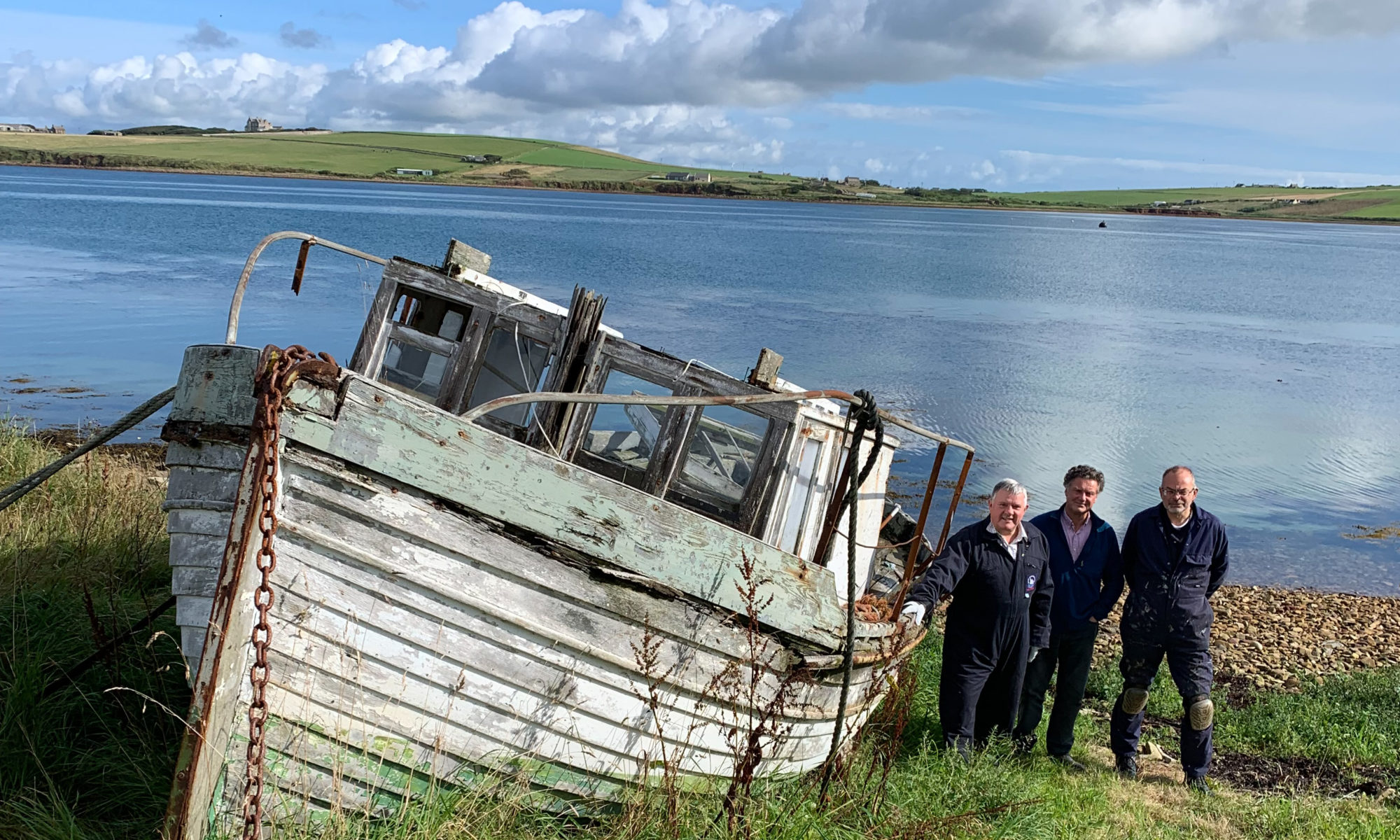
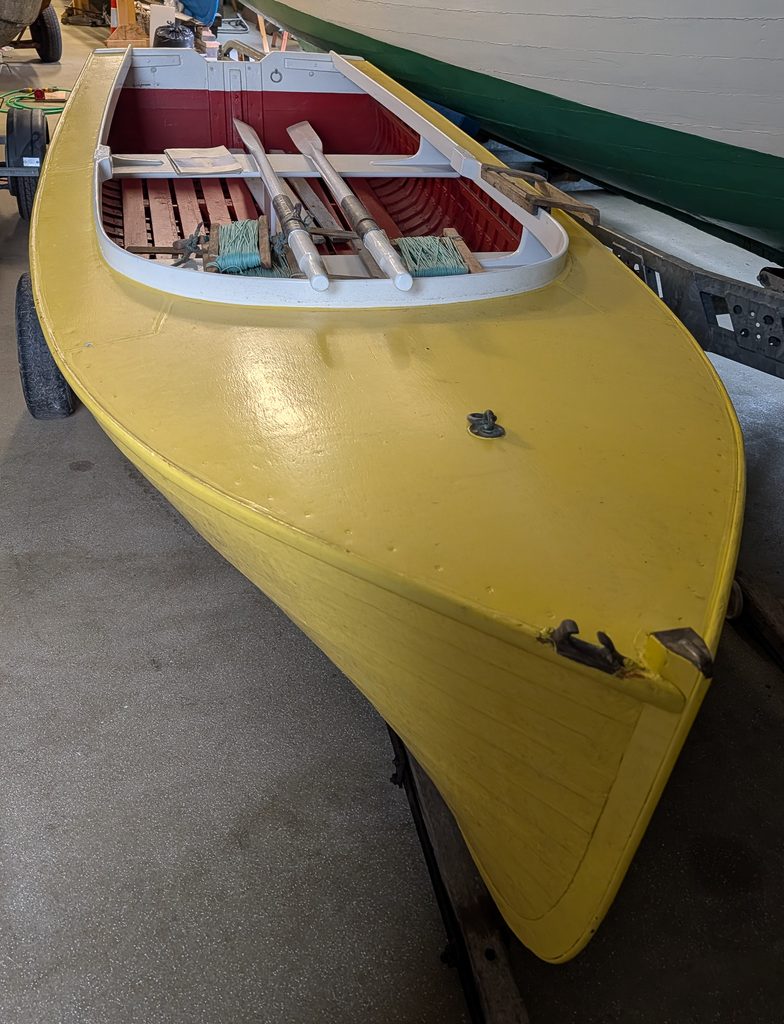
Length 13′ 6″ Beam 4′ 5″
Built at Duncan’s of Burray boatyard in the 1930’s for one Harry Forbes, a retired Clyde engineer living in St Margaret’s Hope. She was designed for motor propulsion and originally this was from a twin cylinder Watermota (marine modified Ford) outboard engine. She is reported to have capsized when being turned too hard at speed in the Hope bay on a Saturday evening back in the day. After that incident the boat was housed and unseen for a long time.
The boat was bought in 1964 by Albert Spence from Eoin Bews of Egilsay. She is an unusual light build for ease of transport, launching and speed. Very close set timmers and thin boards and decking are noted in addition to a reinforced transom. She demonstrates the tumblehome/barrel stern feature seen in Italian (Riva style) and US designs from the
same era. This is a most unusual demonstration of construction in Orkney and is a testament to the versatility of the Duncan’s. She joined this Orkney Historic Fleet accompanied by a rare Archimedes Penta 1960’s outboard.
The following information was provided by Magnus Spence – Nov 2026
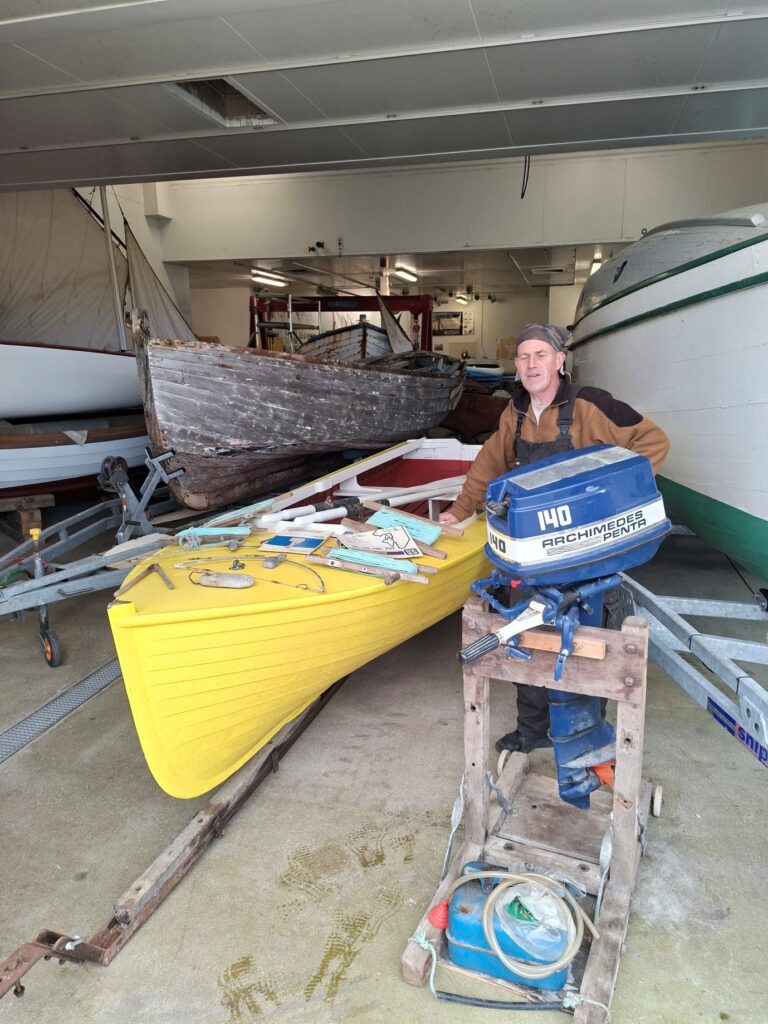
Built by ‘Old’ Jimmy Duncan of Burray using brass nails/screws in the early 1930’s (source: MN) for Harry Forbes in St. Margaret’s Hope (The Hóp), who had to have everything done ‘just right’ (source: HM), and who had, reportedly, obtained a set of plans from an American magazine (source: MN and RD). The design was probably completely unheard of in Orkney at the time. It is unknown if the boat was built in the original shed at West Shore where Jimmy lived or if it was one of the first to be built in the ‘new shed’ at Duncan’s boatyard in the village. Originally driven by a Watermota outboard and capsized by Harry in The Hóp bay one Saturday night, the boat was housed and not seen again ‘for a long time’ (source: WM). This particular evening was a football night in The Hóp and Harry was perhaps ‘showing off’ to the spectators, at which time the boat was thought to have been painted white (source: HM).
The boat eventually ended up in my father’s possession when he purchased it from Ian (Chooker) Bews of Egilsay in 1964. He then proceeded to paint it ‘Post Office Yellow’, using paint he had obtained from the GPO (as they started to move to the more familiar red), with a blue trim around the outer edge of the gunwale and white on the inner gunwale upstand and thafts. Where the red for the inner hull came from is unknown. It is also unknown if there was an outboard on it at the time but my first memory in the early ‘70s is of an old seagull on the back during excursions on the Harray loch when I caught my first trout by trawling a spinner on the way back to shore (don’t tell the Trout Association boys that bit!). My father then purchased the 14hp Archimedes Penta from a shop in Edinburgh in 1972 after which he really only took the boat out around July/August time of year to go to the haddocks off Birsay with myself and my grandfather, George Moar Spence, and occasionally my grandfather’s brother Tom when he happened to be home on holiday from America.
There was a period in the late ‘70s/early ‘80s when the white fish trawlers would slip in at night and clean up the haddock shoals off Birsay as soon as there was word that they were there, so the boat was hung in the roof of the old stable at Linneth until ‘trawling within the limits’ had been clamped down upon and the haddock started to become available for the locals once again. I think it was ’84 when the boat next saw the sea at Birsay but the hull was so ‘gizzened’ that I couldn’t keep up with the ingress of water using a bucket and I threatened to jump out and swim ashore if we went any further. Given that neither father nor grandfather could swim they decided that returning to shore was perhaps the best option. The next few days, during a hose pipe ban, saw the boat sitting on the trailer at Linneth with the hose running in her continuously until she was tight enough to go to sea safely (don’t tell the former Water Board boys that bit!) My grandfather died the following April so the boat’s final haddock trip was in ’85 when the catch was disappointing poor.
The next, and last time, she felt water pass beneath her hull was sometime in the mid ‘90s when I asked my father for a loan of her to go out to the salmon cages in Weddell Sound whilst the fish farm dory was out of the water for a major overhaul. I had a 20hp Evinrude at the time so decided to try that on her to see how she would perform. She was eyewateringly fast with that on the stern! Being acquainted with Harry’s ‘couping’ incident I was extremely cautious whilst cornering but nonetheless decided I would endeavour to find out what might have happened that fateful day. We had always assumed that Harry’s Watermota was overly heavy and powerful for the boat and that, as he had corned, the stern had been rotated beneath the waterline on the inside of the turn. With this in mind, and whilst under full throttle, I gently pushed the tiller away from me into a left-hand turn and carefully watched over my left shoulder to see if the water was going to start lipping in over the stern corner. No matter how much tiller I applied the water level at the stern remained the same with no indication of submergence becoming imminent. Suddenly, and without warning, she lept completely out of the water in the direction of the outside of the turn! Fortunately, the instantaneous acceleration perpendicular to the turn that arose from this dramatic event gave rise to me inadvertently pulling the tiller sharply towards myself and, when she landed back in the water, she shot off in a straight line. My heart was now doing the same number of bpm as the outboard had been doing rpm and I immediately headed for the shore, as I suspect Harry had done all those years ago, for a change of underwear.
Subsequent analysis of this traumatic event led me to notice that the boat’s keel had been deepened by around 3 inches over its entire length with an addition to the hull’s integral keel. This was perhaps added during the build by Jimmy Duncan who, I suspect, would have quite rightly considered a decent keel essential to a boat’s satisfactory functioning, but of course, skilful as he was, Jimmy wasn’t a speed boat builder. Indeed, this ‘good keel’ would have aided with straight line stability and reduction of drift whilst stationary but, given that a hydroplaning hull needs to be able to ‘side slide’, this additional keel leads to a build-up of water on its outside surface during a turn which can only escape by being forced beneath the keel and consequently causing the boat to jump out of the water. On hind sight, consideration of this little bit of hydrodynamics before I attempted a high speed turn may have been a wise course of action.
Watermota
According to the Watermota website, the company was established at the Pembroke Engineering works at Hampton Wick, Kingston upon Thames in 1911 by Walter Fair as a subsidiary of Rigbys, a London gunsmith where he was manager. The first engines produced were American Waterman two stroke inboards and outboards built under licence then, during WW1 when the company had moved over to making cocking levers for machine guns and various aircraft parts, Watermota were approached by the Admiralty to design and produce an outboard for them. The result was the Mark 1 which was produced up until 1926 when it got a revamp for outboard motor boat racing for Walter’s son Colin and Shingo Yano, a Japanese engineer who had previously worked for Anzani. This brought the engine up from a 292cc, 3 ½ hp @ 900 rpm workhorse to a 347cc, 15hp @ 4,500 rpm racer and in 1927, Colin in British Maid II and Shingo in Bullet II, raced the first British built outboards in the first ever outboard motor boat race in England. In the absence of stronger evidence, I suspect that Harry’s boat was fitted with the 15hp version and whilst studying the Watermota website I noticed, with some surprise, that a photo of a trade exhibition contained a boat very similar in design to that of Harry’s. Subsequent enquiries with Watermota unearthed a brochure for ‘Speed Dinghies’ sold by Walter D. Fair & Co.
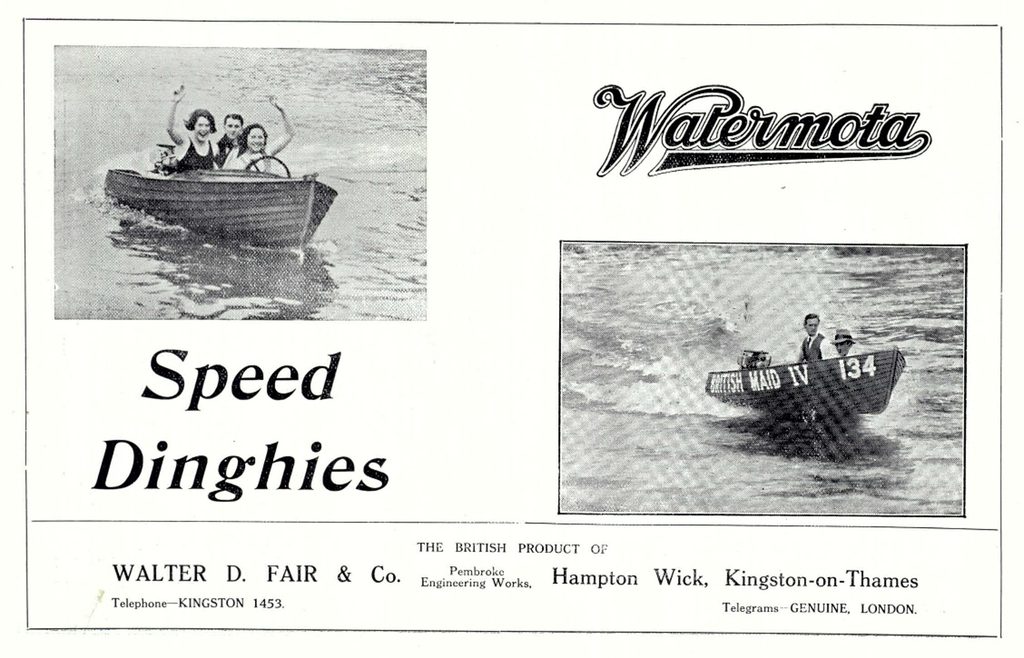
This gave rise to the suspicion that perhaps Harry had bought his outboard plus a set of plans from Watermota at the same, but then again, maybe Walter Fair had been using plans that originated from America and simply passed his contact onto Harry.
Shingo’s Bullet II and the Watermota outboard that powered it can be found on the Science Museum Group’s website, but an image of Colin’s British Maid II, ideally along with a set of plans, is yet to be found.
The above brochure and an article in Motor Boat and Yachting magazine from October 2003 suggests that there could have been a series of British Maids built to a similar design and it may just be possible that ‘Albert Spence’s 13.5ft Clinker Built Boat’ could be the only remaining example of a boat raced by Colin Fair in the first ever outboard motor boat race in England. The thirst for knowledge continues.
Archimedes Penta
<Work in progress>
Harry Roland Norquay Forbes (b. 1892 d. 27/5/61 aged 69)
Harry was born in Cathcart, Lanarkshire and served his apprenticeship as an engineer on the Clyde but is recorded in the 1921 census as being in West End, St. Margarets Hope (The Hóp). It appears that, for a while, Harry was a keen footballer and as a veteran of WW1 he became a member of The Hóp L.D.V. (Local Defence Volunteers/ Homeguard). Part of that role was to ride around on his motorbike warning of air raids and on one such occasion, when he was going round Herston, he informed Jimmy Dunnet that there was an air raid imminent to which Jimmy replied ‘Thur gettan a fine day fur hid’ (source: HM). In the late 50’s he lived in a curtained off section of the shed attached to the Old School House on Forbes Brae, The Hóp, which, for a time, he shared with Herbert MacKenzie’s Snipe (also built by Duncan’s) whilst a Jessie J Sinclair lived in the school house itself (source: HM). There is no memory of Harry being in anyone’s employment from the 50’s onwards but he had a well-appointed workshop in his shed and presumably did bits of jobs for folk as well as maintaining his other two boats which were an Orkney dinghy and an Orkney yole, the latter of which was painted with trim in a fashion unusual for yoles of the day and raced frequently in regattas in The Hóp (source: HM). All three boats resided in a ‘boat house’ built on the site of the former Hay’s stone cutting yard in front of West End in The Hóp, a photo of which had been printed in the Orcadian on, possibly, the 26th February 1998. (source: HM). The yole had been built by John Cormack who built boats at Quindry S. Ronaldsay (source: MN) and there is photo of it on the Orkney Image Archive with some indication of its later history.
Harry’s grandfather, James Forbes b. 1797 d. May 1890 aged 93 came from Raey in Caithness and was School Master at the school on Forbes Brae, The Hóp. He also taught navigation to pupils of all ages (source: HM). His obituary reported that he had taught Dr Hamilton of Bressay, Sir John Logan (of Logan’s Well fame) and Dr Rae (presumably explorer John Rae). Harry’s father, William Tomison Norquay Forbes b. 1855 d. 28/1/28 aged 73 is recorded in 1881 as being a clerk in Union Bank house, The Hóp, and it is assumed that sometime later had moved away from Orkney. At the time of his death he was then living in the Old School House on Forbes Brae where his father had taught and his son ended up resident of the shed.
Sources
MN – Magnus Norquay of South Ronaldsay
RD – Robin Duncan of Burray
WM – Willie Mowatt, Blacksmith of South Parish
HM – Herbert MacKenzie of The Hóp